Vancouver Villages and School Capacity: What the Public Hearing Revealed
343 people spoke at Vancouver's Villages hearing; 2,245 opposed. Our data shows village catchments with over-capacity, seismically at-risk schools and an unmodeled CSF gap. We surface evidence, not recommendations.
The Coordination Gap
The Villages Plan grants immediate, legally binding zoning permissions for residential density across approximately 13,000 to 14,000 parcels. The corresponding infrastructure response — public education, healthcare, transit — operates on entirely separate planning cycles, separate funding mechanisms, and separate institutional mandates.
This is not a critique of the plan. It is a description of how Canadian governance works. The City of Vancouver has jurisdiction over land use. The Vancouver School Board has jurisdiction over school capacity. The Province funds school capital through a separate process. No binding mechanism requires these three authorities to reconcile their data before density is approved.
The result is a coordination gap. And coordination gaps have costs.
What the Data Shows
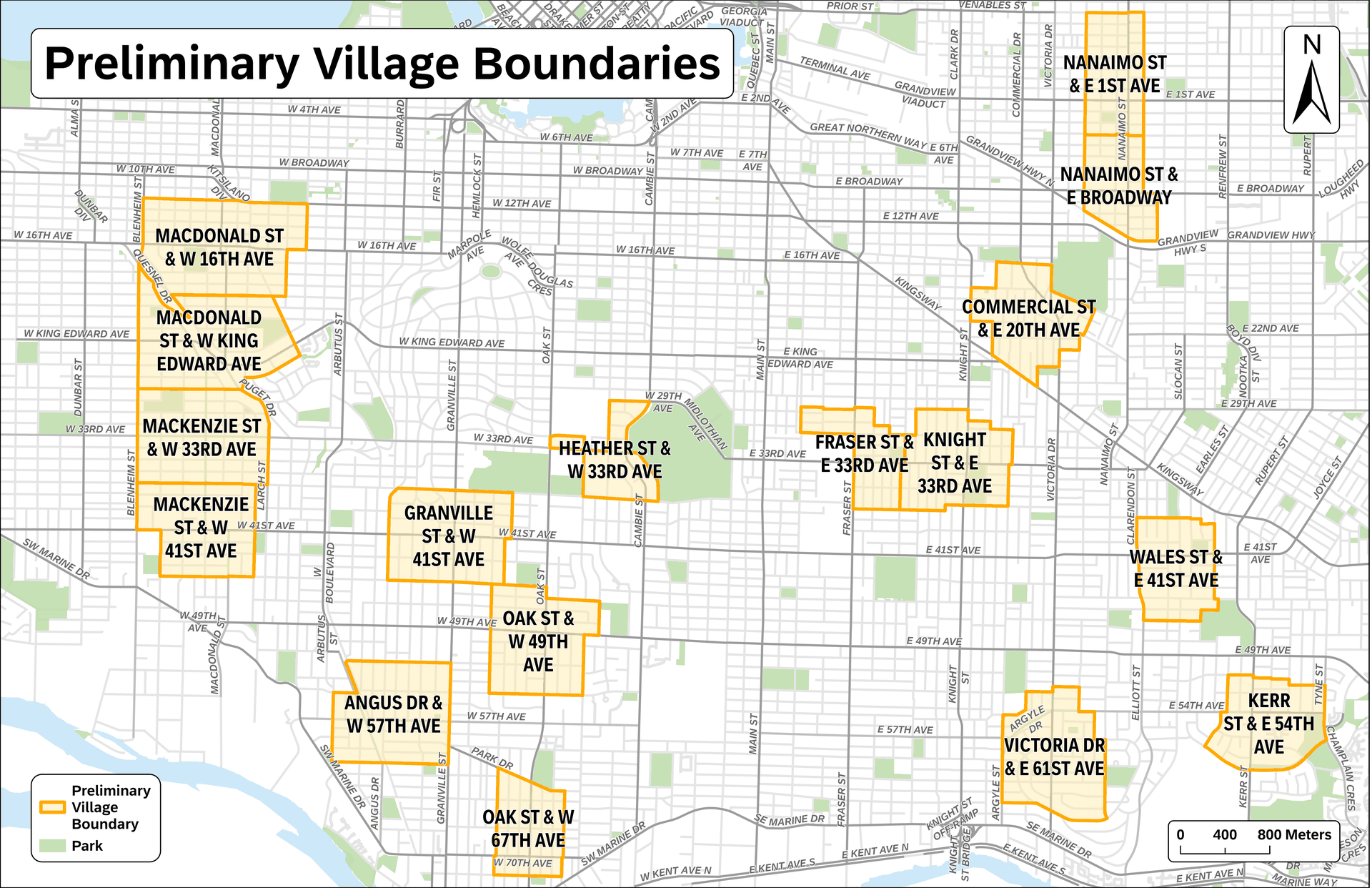
Our interactive tool lets you explore the full picture village by village — select any of the 17 villages on the map, see every school in its catchment, and model enrollment growth under your own assumptions. We make no claims about the accuracy of those projections. It is a tool for thinking, not a forecast.
But several patterns are visible across the dataset without any projection modeling at all. Multiple village catchments already contain schools operating above 100% utilization — in buildings that carry H1 seismic ratings, the highest vulnerability designation. Some of these are listed as Year 1 priorities for structural upgrades. The plan would approve immediate upzoning in these catchments while the schools remain seismically deficient and over capacity.
The facility condition is equally revealing. Schools rated “Critical” and “Very Poor” on the Facility Condition Index appear throughout the village catchments. The VSB’s average school age is 73 years, with $700 million in deferred maintenance across the portfolio. Explore the village-level detail in the interactive tool — select a village and toggle “Include schools within 2 km” to see both direct catchment and nearby capacity.
The Temporal Mismatch
The deeper problem is not capacity today — it is the mismatch between the speed of zoning and the speed of school capital.
When the City approves density, the children those housing units will produce do not appear in the school board’s enrollment projection system until the units are occupied and the children are enrolled. Every school district in BC uses Baragar Systems as its baseline projection tool. Baragar projections do not account for future development still in rezoning, planning, or construction phases.
The school system sees only the children who have already arrived. It cannot see the children who are coming. By the time enrollment data reflects new density, the 5-to-7 year capital project timeline for a new school has not yet begun.
Vancouver has lived this pattern before. Olympic Village was built out for more than 15 years before a school was funded. The resulting Olympic Village Elementary cost approximately $151 million — roughly $238,000 per seat. Carleton Elementary, a 129-year-old school 800 metres from a SkyTrain station in a designated Transit-Oriented Area, was closed on December 17, 2025, while the ODP designated the surrounding area for increased density.
This temporal mismatch is what our interactive growth model is designed to surface. Use the sliders to adjust household size, the percentage of households with school-age children, and the elementary-to-secondary split. Even conservative assumptions produce enrollment pressure in catchments that are already near or above capacity.
The CSF Dimension
There is a second school system operating in Vancouver that was absent from the public hearing. The Conseil scolaire francophone de la Colombie-Britannique (CSF) serves French-language rights holders under Section 23 of the Canadian Charter of Rights and Freedoms.
CSF operates at 151% utilization in Metro Vancouver. In June 2024, the Supreme Court of British Columbia ruled in Conseil scolaire francophone de la Colombie-Britannique v. British Columbia that the Province had systemically underfunded CSF capital for two decades, resulting in inadequate facilities and violations of minority language education rights.
When density is approved in a Village catchment, it affects both school systems. The Villages Plan correspondence does not reference the CSF. Neither does the referral report. The Charter obligation is not mentioned in the staff presentation.
VTCo was the only party among 356 written submissions to the previous ODP hearing to surface the CSF capacity gap and its constitutional implications. Our interactive tool indexes VSB schools; the CSF layer is a dimension that remains unmodeled in any public planning document we have found.
What This Is Not
This analysis is not an argument against housing. Vancouver needs housing. The Province has mandated it. The federal Housing Accelerator Fund has funded it. The question is not whether to build, but whether the infrastructure data has been reconciled before the zoning is approved.
This analysis is not an argument against the Villages Plan specifically. The same coordination gap exists in every growth corridor in British Columbia. The West Shore corridor outside Victoria has the same structural disconnect between SD62’s school capacity and the municipalities’ density approvals. The pattern is provincial, not municipal.
And this analysis is not a recommendation. VTCo does not recommend. We surface what is in the public record, reconcile data that institutions have not reconciled, and show the trade-offs that become visible when you index everything to the same geography.
The Team
This work was produced by the VTCo analytical team: Josh Messmer (CTO, data architecture), Nikhil Sawal (relationship intelligence), Rohan Khanna (research), and Brent Smithurst (COO, operational coordination). Professor Charles Ungerleider, former Deputy Minister of Education for British Columbia, serves as Special Advisor on education systems. The Social Infrastructure Database covers 57,936 Dissemination Areas across Canada, with Metro Vancouver as the densest substrate.
What Happens Next
Council debates and decides on July 28. Whatever the outcome, the school capacity data does not change. The coordination gap between zoning approvals and infrastructure funding is structural. It will persist until a reconciliation mechanism exists — a shared data layer that forces cross-jurisdictional visibility before density is approved, not after.
That is what we build. Explore the data yourself.
Vik Khanna is CEO and co-founder of The Visual Thinking Company Inc. (BC Corporation No. BC1529314). VTCo builds the Social Infrastructure Database, a cross-jurisdictional civic intelligence layer for Canadian communities. This analysis is based on publicly available data from the Vancouver School Board, the City of Vancouver, Statistics Canada, and provincial capital plan records.
The VTCo blog publishes evidence-based analysis of Canadian civic infrastructure. We do not advocate for or against any policy position. Our decision boundary is immutable: surface evidence, reveal contradictions, show trade-offs.